The New Wave of Burgundy
Why It Matters Now, and Where Value Is Forming
BURGUNDY
Luke Mircea-Willats
2/1/20264 min read
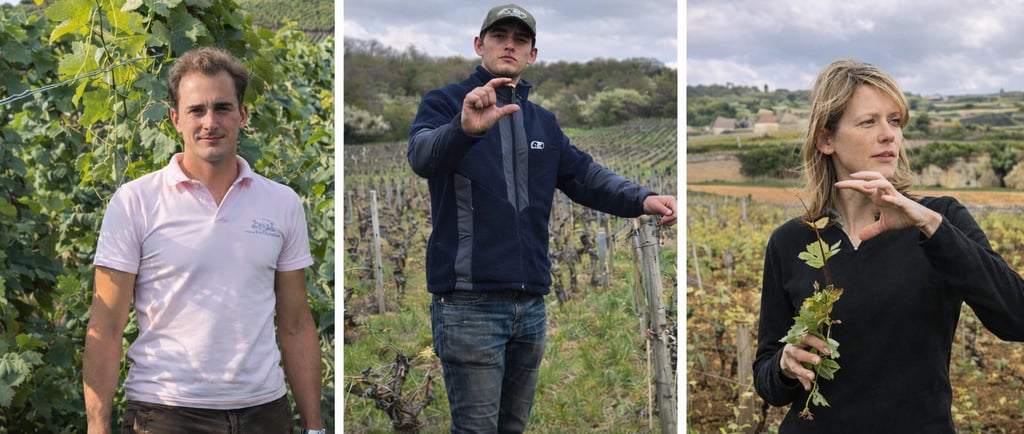
For generations, Burgundy’s hierarchy was built on inheritance. Vineyards were passed down, reputations compounded over decades, and stylistic change came slowly, if at all. Today, that model is being stress-tested.
Climate pressure now rewards freshness over force. Land scarcity has priced out an entire generation. And global collectors have grown more selective, increasingly drawn to wines that age through balance rather than extraction. What is emerging is not a unified style, but a shared conviction: vine health over cellar intervention, energy over power, restraint over gloss.
Rather than catalogue dozens of names, the most straightforward way to understand this shift is through a small number of signal producers. Winemakers whose philosophies already define where Burgundy is heading, not where it has been.
Charles Lachaux
When Charles Lachaux assumed control of Domaine Arnoux-Lachaux in Vosne-Romanée, the estate was respected but largely conventional. His response was neither cosmetic nor incremental. He dismantled accepted norms and rebuilt from first principles, beginning in the vineyard.
Hedging was abandoned. Individual stakes replaced trellising, even in grand cru parcels. Canopies grew taller, yields dropped drastically, and soil health became the central organising principle. Nothing was done to chase volume or uniformity. Everything was done to restore equilibrium in the vine.
The cellar followed the same philosophy. Whole-cluster fermentations, minimal extraction, little new oak, and sulfur are often added only at bottling. The wines did not become larger or more forceful. They became clearer: fragrant, tensile, and precise, capable of carrying intensity without weight.
What Lachaux demonstrated, visibly and irreversibly, is that transforming how vines grow can reset both quality and reputation within a remarkably short period of time. That lesson has travelled fast across Burgundy.
The market response was emphatic. Prices multiplied, allocations vanished, and Domaine Arnoux-Lachaux moved rapidly into modern blue-chip territory. For collectors today, this is no longer a question of discovery or speculative upside. It is about owning a reference point, a marker of when Burgundy decisively changed direction.
Jane Eyre
Jane Eyre tells a very different story, and an equally important one.
Arriving in Burgundy without land, capital, or family history, Eyre built access through trust, rigour, and a quietly confident palate. Working as a micro-négociant, she sources fruit with extreme selectivity, prioritising growers who share her commitment to sustainable farming and naturally low yields.
Her wines are picked early and handled with restraint. There is no attempt to build architecture through oak, no stylistic watermark beyond balance itself. The hallmark is lift: clarity of fruit, fine tannin, and an ease of movement that makes the wines both transparent and quietly persistent.
Eyre matters because she demonstrates how Burgundy’s future elite will expand beyond inheritance. As vineyard ownership becomes increasingly inaccessible, talent is finding alternative routes in, reshaping the region from the edges inward.
From an investment perspective, the signal is already there. Several of Eyre’s premier cru bottlings still release materially below equivalent vineyards from long-established domaines, despite comparable farming discipline and meaningfully smaller production. Scarcity here is structural, not engineered, and demand continues to broaden as consistency compounds across vintages.
This remains one of Burgundy’s clearer early-to-mid phase value stories, not because it is undiscovered, but because it is not yet fully priced for what it represents.
Théo Dancer
At Domaine Vincent Dancer, the generational transition has been transformational rather than symbolic.
Théo Dancer assumed control in his early twenties and immediately intensified the estate’s viticultural direction. Dense plantings replaced conventional spacing. Echalas training was introduced. Tractors were removed from the vineyard. Agroforestry began to take shape between rows. Harvests moved earlier, and new oak disappeared entirely from the cellar.
The resulting wines, particularly the whites, are precise, saline, and architectural. They are built around tension rather than richness, expressing site through line and length rather than weight. In warmer years, especially, they illustrate a fundamental truth now facing Burgundy: farming decisions have become the primary stylistic determinant.
Dancer matters because he represents a third path for Burgundy’s future. Not the outsider forcing entry. Not the iconoclast rejecting tradition. But the inheritor who meaningfully redefines a legacy estate from within.
The only open question is not quality, which is already evident, but classification in the market: whether Théo Dancer will ultimately be viewed as an evolution of a grand domaine or as a stylistic reset at a level comparable to Burgundy’s modern elite. As production remains microscopic and stylistic confidence continues to assert itself, pressure is likely to build.
What This Shift Does Not Mean
Not every low-intervention Burgundy is investable. Scarcity alone does not confer value, and philosophy without execution rarely endures. The producers that will matter over the long term are those who combine conviction with repeatability, allowing precision, rather than rhetoric, to define their wines.
Across these producers, value is no longer emerging from labels alone, but from decisions made years before bottling. In some cases, the market has already caught up, turning vision into a benchmark. In others, pricing still lags behind structural scarcity and stylistic clarity. What unites them is not hype, but inevitability.
The Grand Cru Select View
This new wave is not about chasing novelty or promoting an ideology of farming. It is about recognising that Burgundy’s future will belong to wines grown for balance, shaped by restraint, and defined by vine health long before harvest.
For collectors willing to buy conviction before consensus, this is where the next decade of Burgundy is already being written, quietly, precisely, and permanently
Considering your next wine decision? Whether you are reviewing a cellar, considering an auction lot, building a collection, or rethinking a restaurant wine program, an initial conversation can help clarify the right next step.
© 2026. All rights reserved.
Independent fine-wine insights, vintage analysis, and advisory for private collectors, fine-wine buyers, and restaurants. No commercial bias.