Oak, or Not to Oak?
Is oak really going out of fashion, or has the wine world simply learned to use it better? Grand Cru Select explores how global wine regions, restaurants, and winemakers have quietly recalibrated their relationship with oak over the past decade, and what that shift means for collectors, lists, and long-term value.
WINE TECHNIQUES
Luke Mirces-Willats
1/24/20264 min read
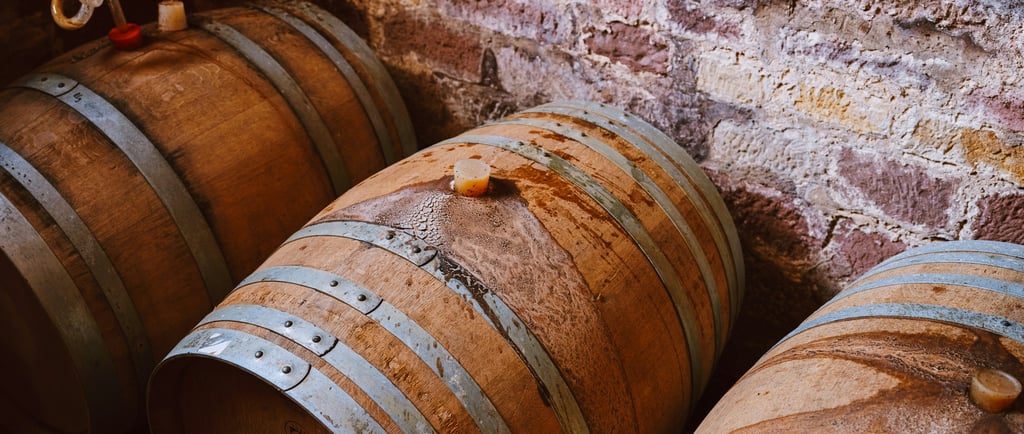
For much of the last decade, one question has hovered over the wine world: Is oak going out of fashion?
The idea surfaces regularly in tasting rooms, on wine lists, and across social media feeds where “unoaked” has become a badge of virtue.
Yet this framing misses the point. Oak has not disappeared from serious winemaking, nor has it been rejected by the producers whose wines age, travel, and endure. What has changed is how confidently and selectively it is used. The shift we are witnessing is not a stylistic rebellion. It is a global correction.
A decade of recalibration
In the 1990s and early 2000s, heavy oak filled a clear role. It added sweetness, polish, and immediacy. In a market shaped by global scores and international benchmarks, new barrels became shorthand for quality and ambition.
Over time, the limitations of that approach became increasingly apparent. Excessive oak dulled freshness, softened the distinction between sites, and imposed a sameness across wines that should have tasted profoundly different. By the mid-2010s, producers across regions began to pull back, not dramatically, but deliberately. T
California: from polish to proportion
California offers one of the clearest case studies. Twenty years ago, generous new oak was almost compulsory for premium Cabernet Sauvignon and Chardonnay. It delivered power, hid vintage variation, and travelled well in an export-driven market.
As alcohol levels rose and palates matured, that model began to strain. Over the past decade, leading producers in Napa and Sonoma have steadily reduced new oak percentages, shortened élevage, and placed greater emphasis on acidity and site character. Oak did not disappear; it stopped dominating.
Today’s best Californian wines still rely on barrels for structure, stability, and longevity. They are simply quieter about it and more precise.
Burgundy and Bordeaux: refinement rather than rebellion
In Europe’s classical regions, oak was never optional, but its expression evolved.
Bordeaux, in particular, has spent the past decade unwinding excess. Compared with twenty years ago, most leading châteaux now use less new oak, lighter toast levels, and shorter barrel ageing. Climate change has delivered natural ripeness and concentration, reducing the need for oak to artificially add volume or richness. The result is not austerity, but clarity.
Burgundy illustrates a complementary truth. Oak never shouted there, so it never needed silencing. Producers refined their touch further, reinforcing a central principle: what matters is not whether oak is present, but how seamlessly it is integrated.
Rioja and Spain: confidence without overt oak
Rioja’s global reputation was built on oak, particularly American oak, and the region has not disowned that heritage. What has changed is confidence.
Over the last decade, many producers have diversified their approach, incorporating French oak more selectively, moving toward larger barrels that soften impact, and introducing concrete or amphorae alongside traditional casks. Rioja still ages, still develops complexity, and still rewards patience, but today, place speaks before process. This evolution has expanded Rioja’s stylistic range without erasing its identity.
Australia: the pendulum finds its centre
Australia perhaps shows the fullest arc of correction. After the heavily oaked styles of the 1990s fell out of favour, a swift swing toward lean, oak-averse wines followed. In some cases, pleasure was stripped away along with excess.
Today, a more stable middle ground has emerged. Cooler sites, earlier harvests, neutral oak, and a focus on texture rather than sweetness define the country’s most compelling wines. Australian Chardonnay’s resurgence over the last decade owes much to this rebalancing: oak returning as structure, not flavour.
The natural wine effect
While still niche in volume, natural wine has exerted a disproportionate influence on the broader market. It reframed expectations around transparency, freshness, and trust in raw material. Even producers far removed from the natural label absorbed its underlying message: if the fruit is strong enough, intervention can step back.
Oak, in that context, became something to justify rather than assume. It was no longer the default solution, but a deliberate choice.
New tools for a quieter approach
This philosophical shift was accompanied by a technical one. Winemakers did not simply use less oak; they expanded their toolkit.
Stainless steel has taken on renewed importance as a precision instrument, preserving aromatics and clarity. Concrete, in various forms, has re-emerged for its ability to provide texture and gentle oxygen exchange without flavour. Amphorae and clay vessels, popularised by the natural wine movement, are now used more pragmatically, often blended with barrel-aged wines to add lift and definition. Meanwhile, large-format oak (foudres, demi-muids, and puncheons) has become increasingly common, offering the benefits of wood without overt oakiness. Barrels were not eliminated. They were reframed from decoration to architecture.
What this means for restaurants
Restaurants have been among the clearest accelerants of this evolution. Modern wine lists reward agility. By-the-glass programmes demand wines that refresh rather than fatigue, and contemporary cuisine favours precision over weight.
In this environment, heavily oaked wines often struggle. They dominate pairings, require explanation, and turn inventory slowly. Balanced wines with discreet oak integrate more naturally with food, move faster, and invite repeat pours.
Oak has not left restaurant lists, but it has become situational rather than ubiquitous, anchored to specific dishes, offered confidently in a bottle, and framed as intentional rather than default.
What this means for collectors
For collectors, the implications are subtle but essential. Wines built today may be less immediately demonstrative, but they are often more resilient. Balance, freshness, and quiet structure tend to age more predictably than sheer impact. Unoaked does not mean superior, just as oaked does not mean outdated. What matters is intent, proportion, and confidence.
Oak, re-understood
Oak has not fallen out of fashion. Overstatement has.
Over the last decade, the wine world has not abandoned tradition. It has relearned it, with better vineyards, better tools, and better judgement. Oak has moved from headline act to supporting role, from flavour to framework, from statement to structure.
At Grand Cru Select, that is where our focus lies: on wines built not for trends, but for time. Because fashion is fleeting. Structure, balance, and patience tend to age better.
Considering your next wine decision? Whether you are reviewing a cellar, considering an auction lot, building a collection, or rethinking a restaurant wine program, an initial conversation can help clarify the right next step.
© 2026. All rights reserved.
Independent fine-wine insights, vintage analysis, and advisory for private collectors, fine-wine buyers, and restaurants. No commercial bias.