Etna: A Fine-Wine Region Being Written in Real Time
Discover why Mount Etna has become one of Italy’s most exciting fine-wine regions, from volcanic terroir and ancient vines to Nerello Mascalese, Carricante and the rise of its contrade.
ITALY
Luke Mircea-Willats
7/26/20267 min read
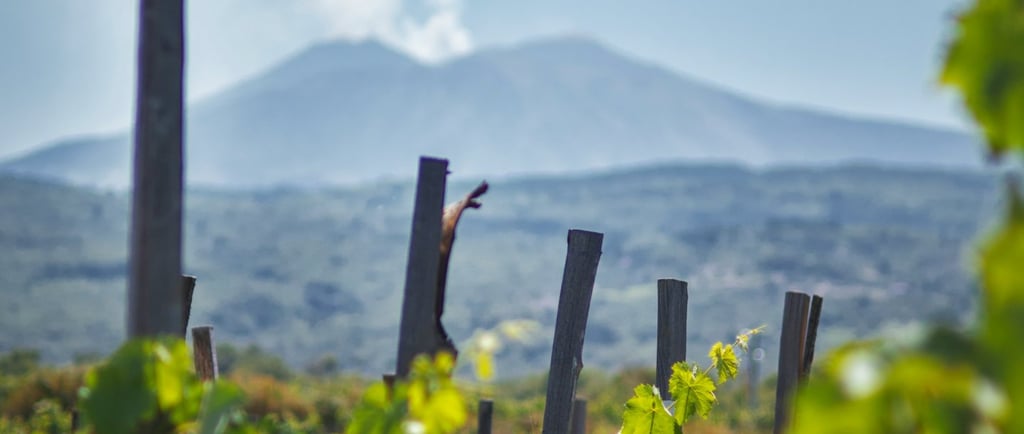
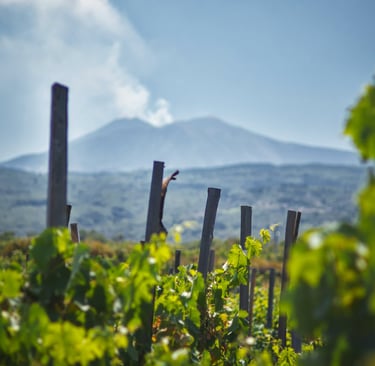
There are few places in the wine world where terroir is quite so visible.
On Mount Etna, vines climb the slopes of an active volcano. Black lava rock surrounds ancient terraces. Some vineyards contain vines more than a century old. And over remarkably short distances, changes in altitude, exposure and the age of individual lava flows create dramatically different growing conditions. It is one of Europe's most extraordinary viticultural landscapes.
But Etna's growing importance is about more than the romance of making wine on a volcano. Over the past two decades, this once relatively overlooked corner of Sicily has become one of Italy's most closely watched fine-wine regions. Collectors and sommeliers are increasingly interested not simply in Etna, but in particular producers, slopes, contrade and vineyards.
We may, in other words, be watching a fine-wine hierarchy develop in real time.
One volcano, many terroirs
It is tempting to reduce Etna to a simple idea: volcanic wine. The reality is considerably more complex.
Etna's soils have been formed through successive eruptions, with different lava flows depositing layers of lava, ash, lapilli, sand and other volcanic material across the mountain. The result is not a uniform volcanic soil, but a geological patchwork. Neighboring vineyards can sit on soils created by entirely different eruptions.
Add changes in elevation, orientation, rainfall and exposure, and Etna quickly becomes something much more interesting than a single volcanic terroir. It is a mosaic of terroirs created by the volcano.
The Etna DOC currently recognizes 133 contrade across its different slopes. These are geographical areas rather than formal quality classifications, but they provide an increasingly important vocabulary for understanding differences across the mountain. The Consorzio itself points to successive lava flows, aspect, soil composition and significant temperature variation as factors distinguishing one contrada from another.
This is perhaps the most fascinating development in Etna today.
The conversation is moving from what does Etna taste like? Towards what does this particular part of Etna taste like? That is a profound change for any emerging fine-wine region.
Mediterranean sunshine, mountain viticulture
Etna also challenges the usual assumptions about Sicilian wine. This is the Mediterranean, but vineyards can climb towards 1,000 meters and beyond. At these elevations, powerful Sicilian sunshine is counterbalanced by significantly cooler nights and pronounced diurnal temperature changes.
The Etna Consorzio reports swings of as much as 25–30°C between day and night in some locations. Those cooler conditions matter. They help extend the growing season and preserve acidity, allowing grapes to ripen while retaining freshness and structure. The result is one of Etna's defining contradictions: Mediterranean intensity without necessarily producing Mediterranean heaviness.
Its best wines can possess ripe fruit and concentration while remaining fragrant, energetic and remarkably precise.
And Etna is not climatically uniform. The northern slope, particularly around Randazzo and Castiglione di Sicilia, has become strongly associated with some of the mountain's most sought-after Nerello Mascalese.
The eastern slope, descending towards the Ionian Sea, is cooler and wetter and is particularly important for Carricante. Milo, on this side of the volcano, is the historic heartland of Etna Bianco Superiore.
The southern and south-eastern slopes receive greater solar exposure, but their vineyards can also reach considerable elevations. Each combination of altitude, exposure and geology creates a different expression of Etna.
Nerello Mascalese: transparency rather than power
The rise of Etna would be far less interesting without a grape capable of translating these differences into wine. For the reds, that grape is Nerello Mascalese.
It can produce surprisingly pale wines with significant acidity and tannic structure, accompanied by red fruit, flowers, herbs and savory complexity. Its combination of delicacy and structure inevitably invites comparisons with Pinot Noir and Nebbiolo. Even the Etna Consorzio notes that Nerello Mascalese is frequently compared with Nebbiolo because of its late ripening and Pinot Noir because of its sensitivity to vintage and site.
The comparisons are useful. But they can also obscure what makes Etna interesting. Etna does not need to become the Burgundy of the Mediterranean.
The greater achievement is that the best Nerello Mascalese increasingly tastes unmistakably of Etna. Its ability to reveal differences between sites gives collectors something beyond simple quality: the opportunity to explore variations of place.
A bottle from Rampante can be tasted alongside one from Calderara Sottana or San Lorenzo. The producer may be the same. The grape may be the same. Yet the expression can differ. That is where fine wine becomes particularly compelling.
Ancient vines and a landscape almost lost
Etna's vineyards also contain something increasingly rare in European viticulture—old vines.
Some parcels include ungrafted vines more than a century old, surviving from before phylloxera transformed most European vineyards in the late nineteenth and early twentieth centuries. The volcanic and particularly sandy soils in parts of Etna helped protect isolated vineyards from the pest.
Many of these vines are trained using the traditional alberello system: individual bush vines grown among terraces constructed from black volcanic stone. The Consorzio describes some of Etna's vineyards as among the oldest cultivated in Italy, including centenarian ungrafted vines, while alberello remains one of the region's defining traditional training systems. Their importance goes beyond rarity. They are living connections to an older Etna.
The region's modern success can make it appear newly discovered, but viticulture here is ancient. Etna DOC itself was established in 1968, making it Sicily's first DOC and one of the earliest in Italy. What has happened over the past twenty or thirty years is therefore not the creation of a new wine region. It is the rediscovery of an old one.
Learning to read the contrade
Central to that rediscovery has been the increasing emphasis on Etna's contrade. Names such as Calderara Sottana, Feudo di Mezzo, Rampante, Guardiola, Santo Spirito and San Lorenzo are increasingly familiar to serious Etna drinkers. They matter because geology on Etna changes so rapidly.
A vineyard's soil may reflect a lava flow entirely different from one only a short distance away. Elevation may change by hundreds of meters. Aspect alters sunlight, rainfall and wind. The resulting differences can be significant enough for producers to bottle individual contrade separately.
This is where the frequent comparison with Burgundy becomes understandable. Not because Etna is Burgundy. But because the intellectual framework is familiar. Once a region reaches a certain quality level, the conversation begins to move from producer to place.
Carricante and the rise of Etna's whites
For much of Etna's international renaissance, Nerello Mascalese attracted the greatest attention. That is changing. Carricante may prove every bit as important to Etna's fine-wine identity.
This indigenous white variety is particularly associated with the higher elevations and eastern side of the volcano. The Consorzio describes the eastern slope as Carricante's favored terroir and notes the importance of its cooler climate and pronounced day-night temperature variation.
Carricante naturally produces wines with considerable acidity and can combine citrus and floral characteristics with savory, saline and sometimes smoky complexity.
Etna Bianco requires at least 60% Carricante, rising to 80% for Etna Bianco Superiore. At the highest level, these can develop substantially in bottle. That aging ability is important because it broadens the Etna conversation beyond red wine and gives collectors another dimension through which to explore the mountain.
For Grand Cru Select, Carricante is one of the areas I would watch particularly closely. The market may have discovered Etna largely through Nerello Mascalese. Its next chapter could increasingly be white.
Why has Etna attracted so much attention?
Terroir alone does not create a great wine region. It also requires producers capable of recognizing, interpreting and ultimately communicating its potential.
From the late 1990s onward, a new generation of winemakers helped transform perceptions of Etna. Benanti demonstrated the seriousness of Carricante and the aging potential of Etna's whites. At the same time, Marco de Grazia at Tenuta delle Terre Nere brought greater focus to old vines and individual contrade. Andrea Franchetti at Passopisciaro further explored site-specific bottlings, while Frank Cornelissen helped attract international attention through a more radical, highly individual expression of the mountain.
Producers including Girolamo Russo, Graci and Pietradolce have since broadened that picture, showing that Etna is not defined by a single style but by different interpretations of the same extraordinary landscape. Together, they helped establish the foundations of a serious fine-wine region: distinctive indigenous grapes, important vineyard sites and a growing understanding of how individual places express themselves in the glass.
Etna is increasingly discussed as established fine-wine regions are: by producer, contrada, vineyard and vintage, rather than simply as an interesting wine from Sicily.
Why collectors are interested
The timing of Etna's rise is also significant. Many wine drinkers and collectors have increasingly become interested in wines defined by freshness, moderate extraction, indigenous varieties and a transparent expression of site rather than sheer concentration. Etna fits naturally within that movement.
But its appeal goes further. The region possesses many of the characteristics that historically create collectability: old vineyards, limited production, identifiable sites, distinctive producers, aging potential and wines that cannot easily be replicated elsewhere.
There is also still relative value. Compared with the most established wines of Burgundy, Piedmont or Tuscany, many exceptional Etna wines remain obtainable at relatively modest prices.
That makes the region particularly attractive for collectors who are interested not simply in prestige, but in discovery.
Collectability is not the same as investment.
This distinction is important. Etna's increasing reputation does not automatically make every great bottle an investment wine.
Italy has become an important part of the international secondary fine-wine market, and the Liv-ex Italy 100 has been comparatively resilient recently: at the end of May 2026 it stood 1.87% higher year-to-date and 6.88% higher over five years. But that index is dominated by established Italian fine-wine names rather than Etna.
The broader fine-wine market also remains selective. Liv-ex described Q1 2026 as relatively stable, with trade value and volume above the 2025 average but still below Q1 2025 levels. Etna therefore requires discipline.
The Grand Cru Select view
Our preference is not to buy Etna indiscriminately, nor to treat the region as the next speculative fine-wine opportunity. Instead, we would focus on the producers, contrade and individual bottlings where exceptional terroir, old vines, limited production and proven aging potential come together.
Nerello Mascalese offers some of the most distinctive red wines emerging from Italy today. At the same time, we believe Carricante and the finest Etna Bianco deserve particular attention as their reputation for complexity and longevity continues to develop.
There is also considerable appeal in the region's relative value. Many of Etna's finest wines can still be acquired at prices substantially below those of comparable wines from more established fine-wine regions, allowing collectors to build positions based first on quality rather than speculation.
Our recommendation is therefore to approach Etna selectively, but with confidence: focus on the best producers and sites, buy wines with the structure and provenance to develop in the cellar, and let future value be a consequence of quality rather than the reason for buying.
For collectors prepared to look beyond the most established regions, Etna is no longer simply one to watch. It is a region worth beginning to understand, and, selectively, to cellar.
Considering your next wine decision? Whether you are reviewing a cellar, considering an auction lot, building a collection, or rethinking a restaurant wine program, an initial conversation can help clarify the right next step.
© 2026. All rights reserved.
Independent fine-wine insights, vintage analysis, and advisory for private collectors, fine-wine buyers, and restaurants. No commercial bias.