Burgundy 2024: What Jasper Morris’ Verdict Means for En Primeur Buyers
An in-depth look at Burgundy 2024, combining Jasper Morris MW’s insights with a disciplined framework for En Primeur decision-making.
BURGUNDY
Luke Mircea-Willats
1/9/20263 min read
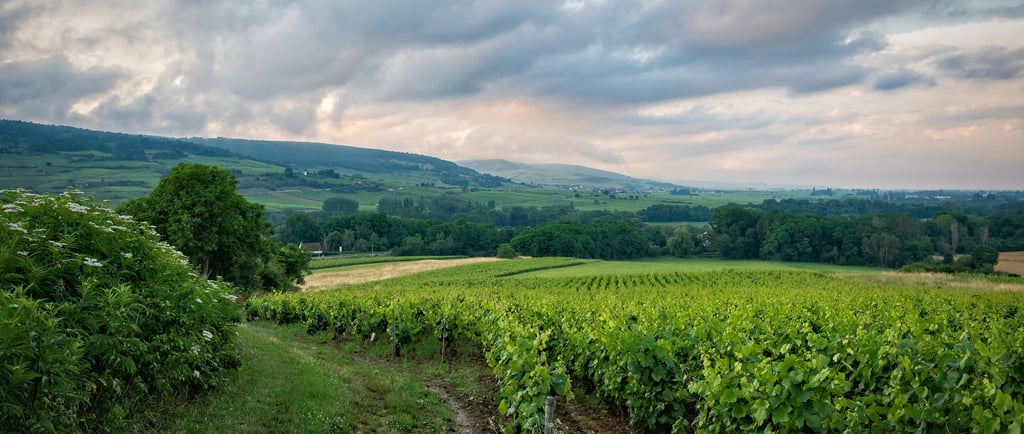
The 2024 Burgundy vintage is not one that reveals itself at a glance.
There is no easy headline, no uniform style, and no broad “buy” signal. Instead, it is a year shaped by sustained pressure in the vineyard, careful decision-making in the cellar, and outcomes that reward precision rather than scale.
In vintages like this, critics matter more than usual. Jasper Morris MW’s overview of Burgundy 2024 provides one of the clearest frameworks yet for understanding what really happened, and what collectors should do next.
This article asks a very practical question: What does Burgundy 2024 actually mean for En Primeur buyers?
A Season Defined by Pressure, Not Collapse
At first glance, 2024 looks like a classic “difficult year.”
Rainfall was relentless. Vineyard soils remained waterlogged for long periods, making vineyard work physically challenging and limiting growers’ ability to intervene precisely when needed. Disease pressure was widespread, with mildew recurring even through the summer months. Hail added to the damage, particularly in Chablis.
And yet, this was not a disastrous vintage.
Rot was largely avoided, which is a crucial distinction. Temperatures were above the long-term average. Only 2010 was warmer in recent history, but a lack of sustained sunshine meant sugar accumulation remained modest. As a result, wines do not show excess alcohol or overt ripeness. Acidity, however, was a point of concern throughout the growing season and into harvest.
Most critically for collectors: yields are extremely low. In several areas, volumes are among the smallest seen in recent years. Scarcity is a structural feature of this vintage.
From Vineyard to Cellar: Decisions That Mattered
The defining feature of Burgundy 2024 is not the weather alone, but how producers responded.
Grapes were small, with very little juice. This naturally increased concentration, but also heightened the risk of imbalance if extraction was handled incautiously. Many growers responded by dialling back ambition and focusing on transparency rather than force.
In the whites, a notable number of domaines favoured a higher proportion of one-year-old barrels. With volumes exceptionally low, many growers were understandably reluctant to invest in large quantities of new barrels for a small crop. Stylistically, this restraint also worked in the vintage’s favour, avoiding the sweetness or structural imprint of new wood and helping preserve clarity and energy in wines where acidity was present, but not abundant.
For reds, the challenges were different. Concerns around acidity and mid-palate weight led some producers to increase whole-bunch inclusion, using stems to add aromatic lift and texture rather than pushing extraction. Pumping over was widely used, generally with restraint.
These choices mattered enormously. Where decisions were well judged, the wines show balance and quiet confidence. Where they were not, issues such as flatness or touches of volatility can appear.
The takeaway is simple but important: 2024 is a vintage where cellar decisions define quality more than terroir alone.
In the Glass: Balance Over Power
Tasted broadly, Burgundy 2024 is not a powerful vintage. It does not aim to impress immediately. Instead, it offers wines built around proportion, freshness, and restraint.
The whites are the clear success story. Across the board, they are good to very good. They show poise rather than tension, with enough structure to age, but without the austerity that marked some recent cooler years.
The reds are more uneven. At their best, they are finely shaped, aromatic, and balanced. Wines that reward attention rather than scale. At their weakest, particularly where picking decisions were delayed, they can feel flat and lacking in energy.
What This Means for En Primeur Buyers
For collectors approaching En Primeur 2024, the implications are clear and demanding.
This is not a buy-everything vintage. Buying broadly, based on habit or label recognition, carries real risk. The dispersion in quality is simply too wide.
Instead, Burgundy 2024 rewards a more disciplined approach:
Prioritise whites, particularly from producers with a strong track record of precision and restraint
Be selective with reds; grower style and picking decisions matter more than appellation hierarchy
Focus on balance and clarity, not concentration or headline scores
Expect scarcity to underpin pricing over time, but do not confuse rarity with quality
Final Thought
Every En Primeur campaign tests a collector’s discipline. Burgundy 2024 does so more than most.
With some early En Primeur pricing already emerging, Burgundy 2024 looks like a vintage where patience may be rewarded. Given the variation in quality (especially with reds), waiting for detailed tasting notes before committing makes sense for all but the most proven producers. In this case, restraint is not risk avoidance; it is part of the strategy.
Considering your next wine decision? Whether you are reviewing a cellar, considering an auction lot, building a collection, or rethinking a restaurant wine program, an initial conversation can help clarify the right next step.
© 2026. All rights reserved.
Independent fine-wine insights, vintage analysis, and advisory for private collectors, fine-wine buyers, and restaurants. No commercial bias.